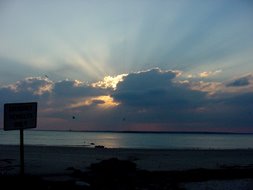
Easter Sunrise
 The light shining through the clouds caught my interest in this photo I took near Jeremy Creek in McClellanville, SC.
May the dawn of this special day bring peace and renewal to you and your loved ones.
Happy Easter!
The light shining through the clouds caught my interest in this photo I took near Jeremy Creek in McClellanville, SC.
May the dawn of this special day bring peace and renewal to you and your loved ones.
Happy Easter!
 I sketched in the Biblical Garden at Magnolia Plantation on the day after Good Friday, surrounded by plants that are mentioned in the Bible. This small formal garden is a hidden gem tucked into one of the largest Romantic Gardens in the country. It's the second year I've painted here on the Saturday after Good Friday.
 "Easter Vigil" is a charcoal drawing of a statue of Mary standing in the center of 12 small square flower beds designed to form the shape of a cross. The 12 flower beds are symbolic of the 12 Disciples of Christ.
The deep shadows and sharp contrasts in my charcoal drawing make me think of Mary as she watched and prayed on that dark day before The Resurrection.
"Easter Vigil"
Charcoal, pastel and conte drawing on paper
Dimensions: 14"x 10.5"
 The subject of my painting "Camellia in the Rain" is a bloom from a bush highlighted as "Camellia of the Month" by the International Camellia Society (ICS) for April 2009.
The International Camellia Society is a non-profit organization with over 2,000 members worldwide. It is the official registrar for the genus Camellia and maintains the International Camellia Register in addition to publishing the yearly "International Camellia Journal ".
On the Society's website @ http://www.camellia-ics.org  is a photograph of the camellia and information about the plant's recent history in the Charleston garden of Mrs. Rose Muschick.
As with many varieties of older heritage camellias, the ancestry of this plant is an open question. Information about the plant from camellia growers, horticulturists, or flora-culturalists is welcomed.
"Plantation Smokehouse" is my plein air painting of a historic outbuilding at Hobcaw Barony, a Historic National Site and research reserve of the Bell W. Baruch Foundation.
In the painting, shadows play on the white side of the smoke house, as Spanish moss sways in the breeze from nearby Winyah Bay.
I used color contrasts and value changes to direct the viewer's eye from the moss filled tree at left, across the smokehouse and off through the shadows to the water in the distance.
"Plantation Smoke House"
Oil on panel
Size: 11" x 14"
Price on request Hobcaw Barony is composed of land that was granted in 1718 as a "barony" to English royalty. It was later sold and subdivided into plantations extending from the Waccamaw River to the Atlantic Ocean. The word "Hobcaw" is a Native American term meaning "between the waters".
The antebellum smokehouse at Hobcaw  was used to cure game caught by the hunting parties to the Barony when it was used as a winter hunting retreat by Bernard Baruch in the early 1900's . Duck, turkey, deer, quail, foxes, and wild boar were hunted by distinguished guests, including President Franklin D. Roosevelt and British Prime Minister Winston Churchill .
 Friendfield Village was home to enslaved Africans and later freedman who lived in the cabins from the early 1800's until 1952. In addition to homes, the village eventually included a school house, doctor's office, and church. The church at Friendfield was built in 1890 with the addition of the bell tower in 1905.
"Friendfield Village Church"
Oil painting on panel
Dimensions : 14" x 11"
Price on request
I had the privileged of joining artists from the Plein Air Landscape Society (PALS) to paint on location at Hobcaw Barony, a 17,500 acre research reserve and historic site managed by the Belle W. Baruch Foundation.
As we painted, work was in progress to preserve and stabilize the wood structures in this former slave community.
Brick footings and fireplaces have been strengthened, roofs repaired and cabins painted.
As at other historic sites in the SC Lowcountry (click here for Magnolia Plantation Slave Cabin Restoration Project), the Belle W. Baruch Foundation realizes the value of preserving the buildings at Friendfield Village to show how enslaved Africans lived on this southern plantation during the days of growing "Carolina Gold" rice in tidal rice fields during the 1800's
 and later as freedman descendants of slaves continued to live and work on the land when it became a winter hunting retreat in the 20th century. Click here to see a historic photo of a wedding party heading to the Friendfield Church.
 I'm renewing my effort on this oil painting of two young girls who are members of a singing group which performs spiritual and sacred music of the SC Lowcountry. Originally I planned to leave the painting loose and "sketchy", but think I'll add a bit more finish to the work.
I've been inspired to resume my efforts by seeing the work of three accomplished artists -Nancy Guzik, Susan Lyon, and Mary Whyte. Each painter brings a sense of spontaneity and freshness to their work which is built on mastery of draftsmanship, paint handling and creative vision.
All three artists have had their artwork featured in recent publications for the members of the Portrait Society of America of which I'm a member. Check out their work and be inspired too.
Now off to my easel...
Spring has sprung in Charleston. People relaxed on benches and blankets, as I drew in my sketchbook at White Point Gardens today.
Here's my charcoal drawing of the "Little Dancer" bronze statue by the accomplished 20th century Charleston sculptor Willard Hirsch at the Children's Fountain in White Point Gardens.
Although a popular attraction for children of all ages visiting the Battery, it's not widely known (because the City Of Charleston has never installed a dedication plaque- click here for article) that the 20" statue was created for the fountain in 1962 from a figure Mr. Hirsch had designed about 15 years earlier. It was cast in bronze in New York and installed on a granite base placed lower to the ground for easy access by children.
Also significant is the fact that the "Little Dancer" statue at the fountain is included in the Smithsonian Institution Inventory of American Sculpture. Click here for link to Siris.
Charlestonian Sallie C. Carrington was the generous benefactor who requested the drinking fountain be dedicated to "The Children of Charleston".
Channel 4 (ABC) News reporter Neville Miller and cameraman Shamir Bryan were also at the park. The men were hard at work surveying people  on preferences for a state marine mammal - the Right Whale or Bottle nosed Dolphin.
When I asked to take their picture,  cameraman Shamir Bryan said he's not used to being on the other side of a camera, but was a good sport and even held the "Little Dancer's" hand as he and Neville took time out for a photo.
 The Bandstand at White Point Gardens is one of the most recognized structures in Charleston. Its charming setting among graceful live oaks near Charleston Harbor makes it a frequent subject of photo's and painting's of Historic Charleston.
Yesterday (3.3.09), the City of Charleston announced an $885,000 project to improve White Point Gardens which includes plans to renovate and restore the 102 yr. old bandstand. A $273,500 contract will include repairs to the 1907 structure's brickwork and will lower the base from its present 6 ft. elevation to the original 3 ft.
I'm posting my recent ink drawing of the bandstand with its 6 foot tall platform rising from ground. I'll need to redraw the structure in the future when the base of the bandstand is lowered 3 feet.
Although it will be nice to see the restoration, I wonder if the bandstand will look quite as grand or provide as nice a view when it's lowered 3 feet to the ground.

Hopefully the White Point Garden renovation plan can be modified to include the long overdue placement of a plaque to identify the Charleston Children's Fountain (click here for article) and its beloved "Little Dancer" bronze statue by Charleston sculptor Willard N. Hirsch.
 Winter is the time for Camellias to bloom in Lowcountry gardens. The Coastal Carolina Camellia Society (2009 Show) says there are now over 20,000 named varieties of Camellias with more being introduced every year. With so many new varieties available to gardeners, the older varieties-referred to as heritage or ancient camellias are sometimes overshadowed by the newcomers.
For over 50 years my  mother, Rose N. Muschick has diligently collected and cared for an ever growing collection of camellias in her Lowcountry garden. Many of her camellias were gifts from friends who have long since passed away.
I was in her garden today painting some of the many varieties currently in bloom. Here's a painting of a "Camellia in the Rain" that I painted from a flower on a bush that is one of her older, "historical" varieties of camellias. I think the variety was named "Princess". I've asked several camellia growers if this is the correct name for the variety but they are unsure due to it's age. These camellias look as if they have a gold "crown" rising from the center of the bloom.
A few of her camellia bushes have so many blooms the branches can hardly hold them.
What a cheerful sight in the middle of winter.
I hope these photos of camellias from  her winter garden brighten your day. Cheers!